Manifold-BT vs RaptorBT
RaptorBT is a genuinely fast Rust engine, and a good one. But “fast backtester” means nothing without the workload attached. On a single backtest, every serious engine answers in milliseconds. On the parameter sweep that actually validates a strategy, the two separate by more than an order of magnitude, and that is the number that decides your research loop. Here is the head-to-head, measured.
Two engines, two different jobs
RaptorBT is built as a drop-in replacement for vectorbt: the same vectorized model and metric set, re-implemented in Rust so a single backtest runs faster than pure NumPy plus Numba. It is small, focused, and quick on one call.
Manifold-BT is a research engine rather than a faster vectorbt. It ingests real market data, evaluates signals vectorized over the full series in Rust, then runs a sequential pass for fills and PnL on an Apache Arrow columnar core, and it exposes the parameter sweep as a single native call that fans out across every core. That last point is where the benchmark below turns decisive.
Side by side
| Manifold-BT | RaptorBT | |
|---|---|---|
| Core design | Rust + Apache Arrow research engine: vectorized signals, then a sequential fills pass | Rust + PyO3 drop-in replacement for vectorbt |
| One backtest (latency) | Leads from ~100k bars (under 10 weeks of 1-min data): 20ms at 1M bars with the full metric suite | Fastest only on tiny series, about a week of 1-min bars; 35ms at 1M |
| Parameter sweeps | One native all-core call, data loaded once: 22 to 25x faster, and 4x faster even on a single core | No sweep API, so a single-core Python for-loop with the GIL in the middle |
| GPU acceleration | Yes, parameter sweeps and Monte Carlo | No |
| Indicators | 35+ incl. KAMA, Hull, Kalman filter, GARCH, regression stats | 12 (SMA, EMA, RSI, MACD, Stochastic, ATR, Bollinger, ADX, VWAP, Supertrend, Rolling Min/Max) |
| Market data | Ingests real data (Binance and other providers) | Bring your own NumPy arrays |
| Walk-forward | Built-in, in-sample / out-of-sample folds | Not documented |
| Execution realism | Market-impact slippage, funding on perps, partial fills, configurable signal delay | Slippage, fees, fixed / ATR / trailing stops, take-profit |
| Best for | Validating a strategy across the parameter map, at scale and on real data | Fast single vectorized backtests on small-to-mid series |
About that “5,800x faster than vectorbt” number
It is the headline that makes RaptorBT sound in a different league, so it is worth understanding what it measures. Much of that ratio comes from comparing a warm Rust run against vectorbt’s first call, which pays Numba’s JIT compilation cost up front. It is a statement about vectorbt’s cold start, not a moat over other Rust engines, and you cannot line it up against Manifold-BT’s own “faster than vectorbt” figure because the two are measured against different baselines. The only comparison that means anything is the two engines, same machine, same strategy. That is what follows.
One backtest: everyone answers in milliseconds
On a single call there is barely a story. RaptorBT is the fastest small-series engine: about 0.02ms on 1,000 bars, where Manifold-BT pays a small fixed floor and vectorbt pays roughly 3.3ms of JIT overhead. From around 100,000 bars the lead flips, and it holds. At one million bars, Manifold-BT answers in 20ms with the full metric suite, RaptorBT in 35ms, vectorbt in 62ms.
Put that crossover in context. At one-minute resolution, 100,000 bars is under ten weeks of data, and one million is under two years. So RaptorBT’s single-call edge only really covers tiny series, a week or two of minute bars; on any realistic minute-resolution backtest, months or years long, Manifold-BT is already ahead on a single call, before you even reach the sweeps below.
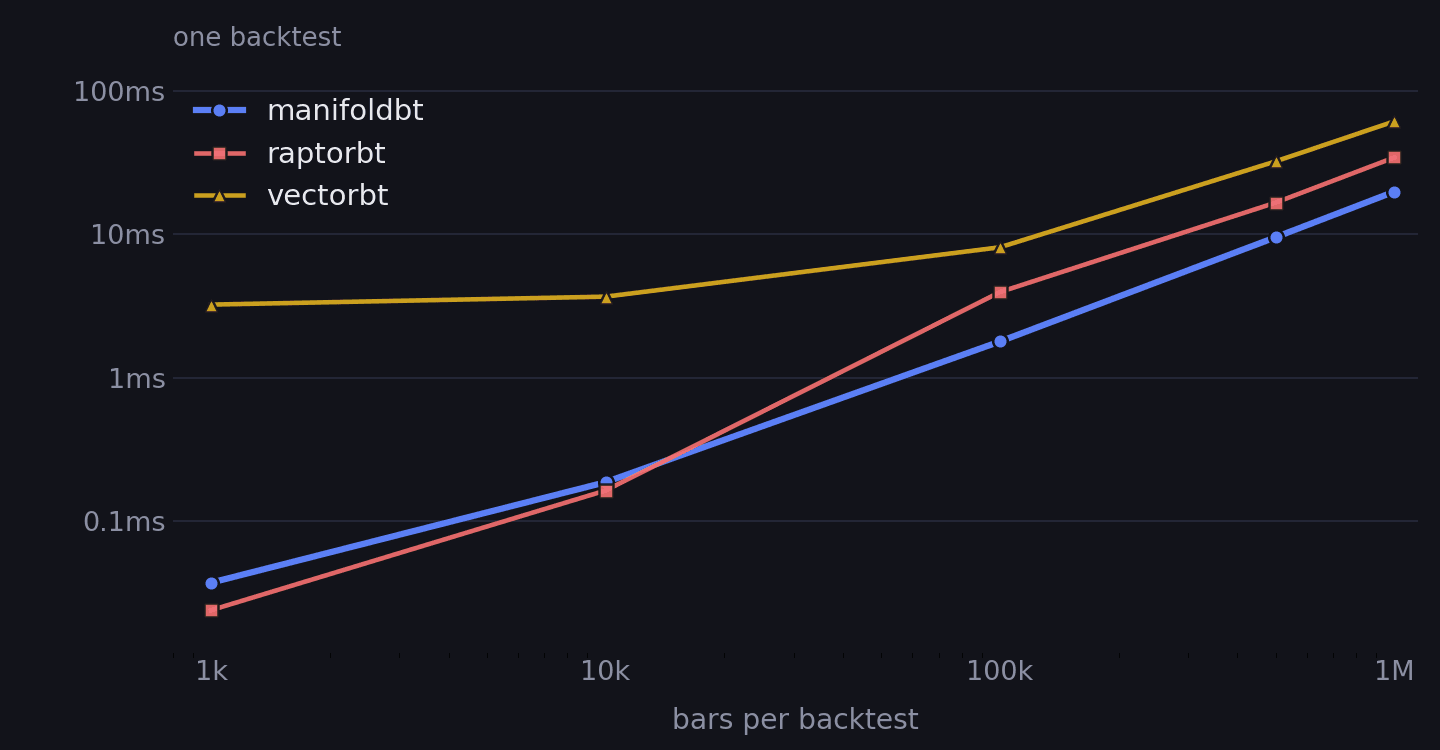
At a human scale, all three are instant. Nobody’s research is gated by a call that costs tens of milliseconds. If engine speed only mattered here, the choice would be indifferent. It is the next workload that decides it.
The map is where they separate
Validating a strategy is not one backtest, it is thousands: sweep the parameter grid, bound the stable plateau, then repeat it for every walk-forward fold and robustness check. That is tens of thousands to millions of calls per idea, and sweep throughput is the metric that actually governs a research loop.
Here the two are built very differently. Manifold-BT runs the sweep as one native call: the grid goes to the Rust core, data is loaded once, and combinations fan out across all cores with no Python in the loop. RaptorBT has no sweep API, so the only option is a Python for-loop over single backtests, one core, the GIL in the middle. Same grid, same data, full-sweep wall time:
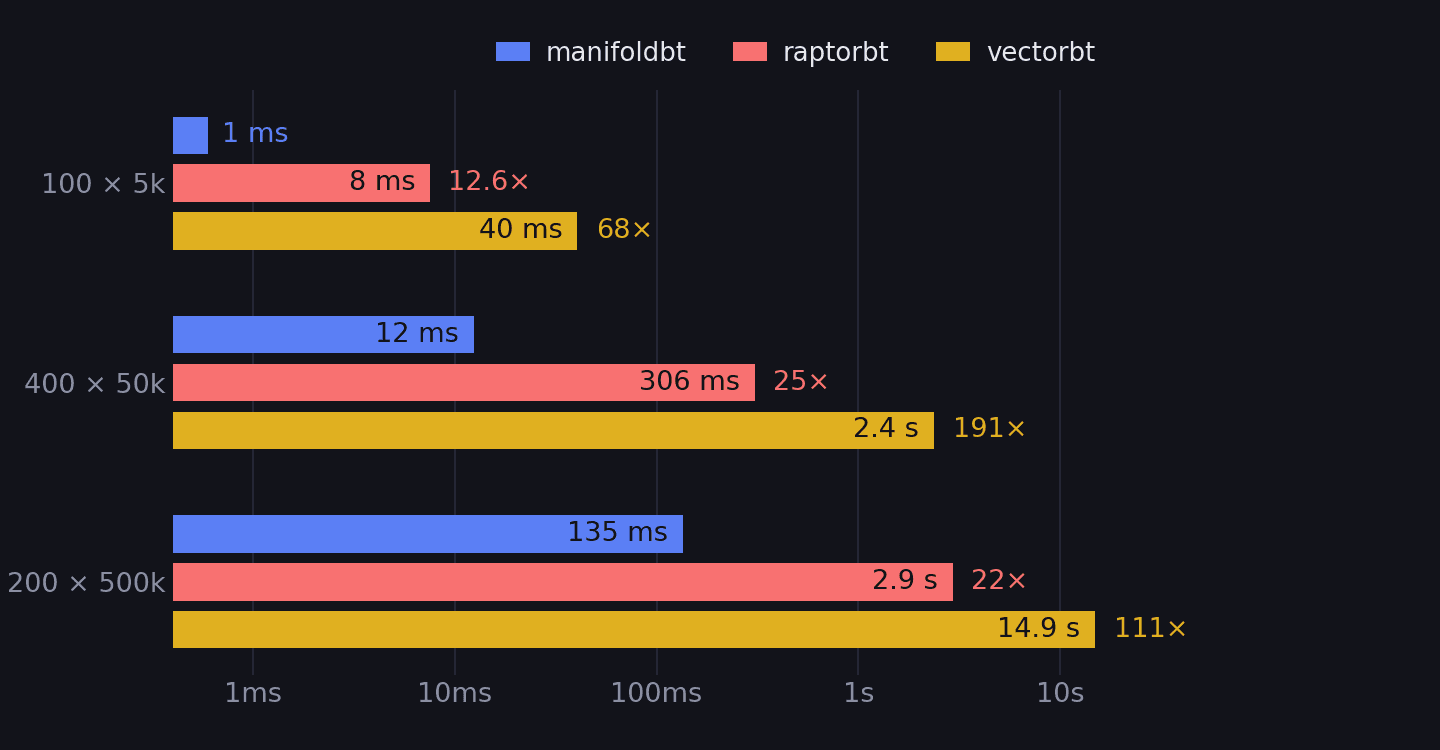
Parallelism is not the whole story. Pinned to a single core, Manifold-BT still runs the large sweep about 4x faster than RaptorBT’s loop, because the batch shares data loading and stays in native code between combinations; the rest is the twenty cores a GIL-serialised loop cannot use. And this is the axis where GPU offload, which RaptorBT does not have, keeps scaling Manifold-BT further.
Those charts were measured on a 20-core workstation. The same comparison also runs in public CI on a free four-core GitHub runner, where the sweep gap came out at about 16x across every grid in the run of 20 August 2026: fewer cores, less to fan a grid across, and the honest floor for the ratio. That run installs both engines from PyPI and publishes the raw JSON, engine versions and machine included, on the benchmarks page.
What that looks like in a working session
Put a real research session behind the ratio. A parameter map of 250,000 backtests, the kind of grid that actually bounds a strategy’s stable region, takes about 7.7 seconds on Manifold-BT’s twenty cores, and 2 seconds on the GPU. The same map in a RaptorBT loop is 3.2 minutes.
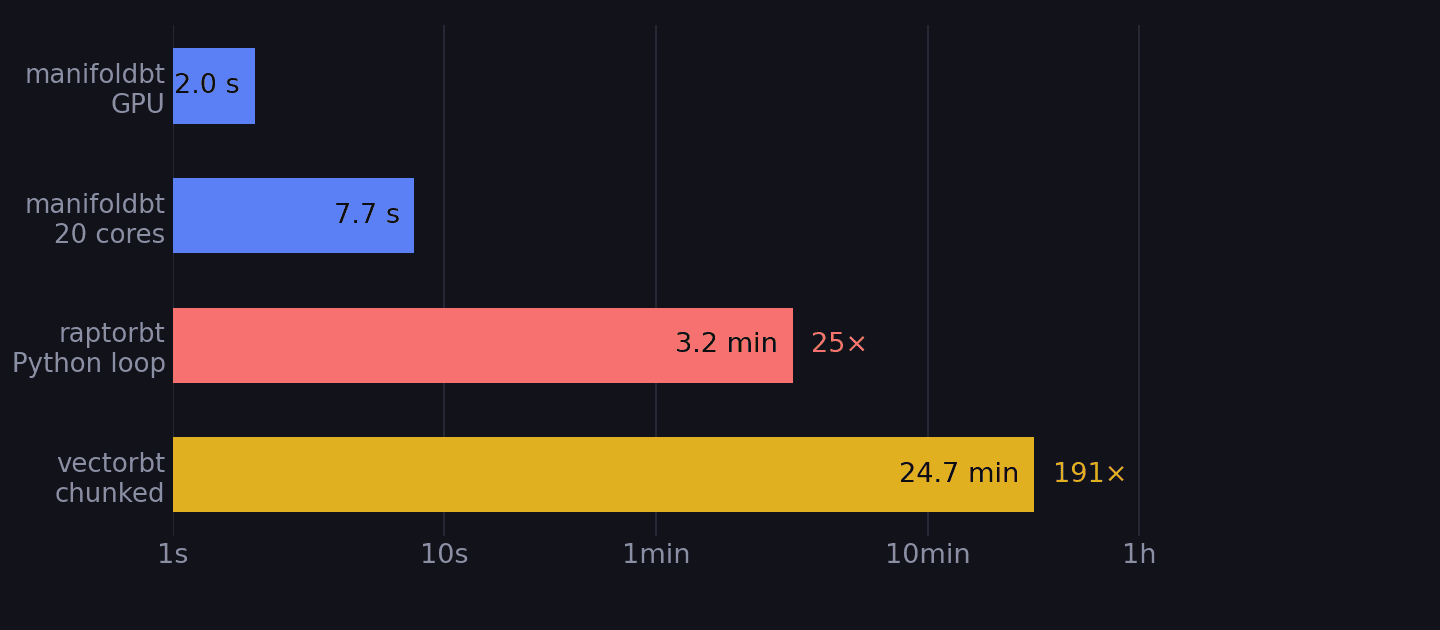
At a few seconds the map is interactive: you read it, change a threshold, run it again. At several minutes it becomes a batch job, and in practice you stop drawing maps and fall back to point estimates, which is exactly the habit that overfits a strategy.
The sweep RaptorBT has no API for
Both tabs run the identical sweep, the same SMA crossover over the same grid, with the same costs. The only difference is the API: in Manifold-BT the whole grid is one native call that fans out across all cores, while RaptorBT has no sweep API, so it becomes a hand-written Python loop over single backtests, one core at a time.
import manifoldbt as mbt
from manifoldbt.indicators import close, sma

# SMA crossover, the two periods declared as swept parameters
fast, slow = sma(close, mbt.param("fast")), sma(close, mbt.param("slow"))
strategy = (
    mbt.Strategy.create("sma_cross")
    .signal("fast", fast)
    .signal("slow", slow)
    .size(mbt.when(fast > slow, 1.0, 0.0))
)

# One native call: the whole grid fans out across every core.
# (config + store are set up once, elsewhere.)
sweep = mbt.run_sweep(
    strategy,
    param_grid={"fast": range(5, 100), "slow": range(10, 300)},
    config=config, store=store,
)
best = sweep.best("sharpe")
import raptorbt as rb
import numpy as np
# No sweep API and no built-in crossover: hand-roll the signals, then loop
# over the grid in Python, one backtest at a time (the GIL keeps it on one
# core). cfg and the OHLCV arrays are set up once, elsewhere.
def crossover(fast, slow):
above = fast > slow
prev = np.concatenate(([False], above[:-1]))
return above & ~prev, ~above & prev
best = None
for f in range(5, 100):
fast = rb.sma(close, f)
for s in range(10, 300): # the nested loop IS the grid
slow = rb.sma(close, s)
entries, exits = crossover(fast, slow)
r = rb.run_single_backtest(ts, o, h, l, close, vol, entries, exits,
direction=1, config=cfg)
if best is None or r.sharpe > best.sharpe:
best = rWhen to choose Manifold-BT
Choose Manifold-BT when high performance means the workload that actually validates a strategy, not just the latency of one call: real market data in, an explicit execution and funding model, a deep indicator library, walk-forward and Monte Carlo, and parameter sweeps that run more than 20x faster and scale from all your cores onto the GPU.
Benchmark notes: one machine (Windows 11, 20 logical cores), a synthetic random walk, an SMA(10/50) crossover translated exactly into each engine, zero transaction cost, timed fastest-of-N with warmup discarded. raptorbt 0.4.0, vectorbt 0.28.4. This is a vendor benchmark, Manifold-BT is our engine, so the harness, the exact strategy translations, and the raw timings are published for you to rerun. RaptorBT is genuinely the fastest engine on small single calls; the ranking that survives the details is the sweep, where the gap is structural.
Keep reading
Run your first backtest
Install Manifold-BT and reproduce the backtest above in seconds. The Rust core runs years of bars sub-second so you can sweep parameters instead of waiting.